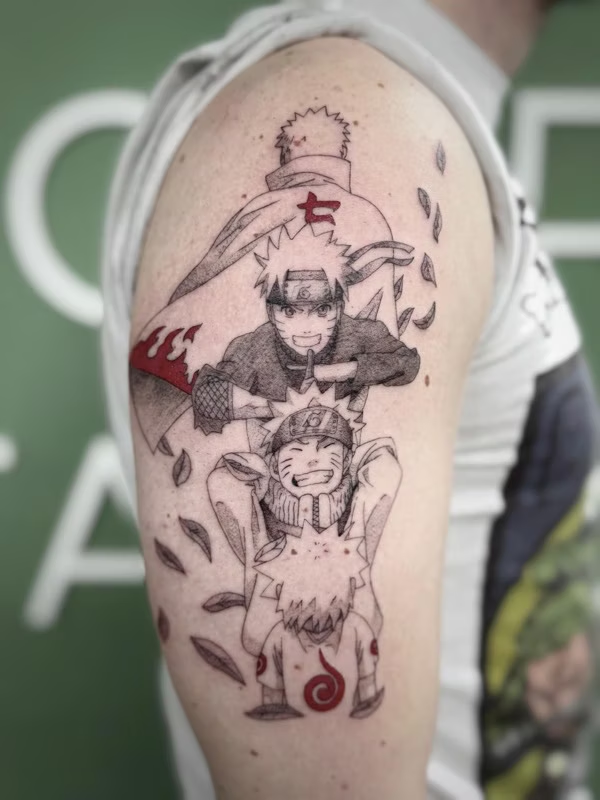
Tattoo Trends 2027: The Most Requested Styles of the Year
The tattoo market in 2027 is more mature and informed than it was even three years ago. Clients do research, compare portfolios, and ask about how styles hold up over time. This has substantially shifted the landscape of trends: people are no longer just looking for "what's in right now," but for what will still look good in ten years. An up-to-date overview of what we see every day in the studio in Turin.
Why 2027 is a turning point
We are in the middle of a significant generational shift in the tattoo world. Generation Z is now the most active demographic in the sector, bringing with it a radically different aesthetic from previous generations: less interest in traditional symbolism and more attention to the overall visual coherence of the body as an aesthetic surface. Tattoos are planned as collections, not as individual moments.
At the same time, awareness of style longevity is growing. People who got watercolor tattoos five or six years ago are starting to see them fade and blur, and this public awareness — amplified by social media — is shifting preferences toward styles with a longer "life" on the skin. Professional considerations also enter the picture: tattoos are increasingly accepted in formal work environments, and many clients explicitly think about placement and visibility when making their choice.
Fine line: still the undisputed leader
Fine line shows no sign of slowing down. On the contrary, in 2027 it has refined further both technically and stylistically. If you're looking for specialists, discover fine line in Turin at ETRA. The trend has moved toward extreme single needle work — single 1RL or 3RL needles producing lines of almost invisible thickness — and toward increasingly elaborate compositions: botanical bouquets with almost woodcut-like detail, handwritten italic scripts, pure line portraits without shading. The effect is that of a fountain pen drawing directly on skin.
The dominant subjects in 2027 fine line are delicate florals (line-work roses, wildflowers, eucalyptus branches), animals in an illustrative style, and astronomical compositions — constellations, moon phases, details from celestial maps. There is also a growing segment of fine line with architectural elements: facades of historic buildings, Gothic windows, ornamental details.
Technical note: single needle fine line is beautiful when freshly done but requires particularly scrupulous care during healing. Ultra-thin lines are the most vulnerable to sun exposure, excessive sweating in the first weeks, and friction from clothing. Clients should be informed about this before choosing the style.
Patchwork and sticker sleeve: building over time
The patchwork tattoo — also called a sticker sleeve for the visual effect of "stickers" distributed across the arm without a unifying background — is one of the fastest-growing styles in 2027. It appeals because it responds to a concrete need of the new generation of clients: the ability to build a tattoo journey progressively, session by session, without having to commit from the start to a total project.
Each piece is autonomous, with its own internal composition and defined borders, but the overall result — when pieces are carefully distributed — creates a coherent visual harmony. The key is planning: even though each element is independent, the relative positioning of pieces must be considered from the start, with the help of an artist who has an overall vision.
The most common styles in 2027 patchwork are botanical fine line, geometric blackwork, simplified neo traditional, and illustrative black and grey subjects. More and more clients are deliberately mixing two or three styles within the same patchwork — a practice that requires a trained eye to avoid looking chaotic.
Blackwork and cybersigilism: the dark side of 2027
Blackwork has stopped being a niche. In 2027 it is one of the most requested styles among the 20–30 age group, with particularly marked growth in two directions: on one hand organic blackwork — patterns of leaves, branches, naturalistic elements stylized in solid black — on the other hand cybersigilism, a young and aggressive movement that blends tribal symbols with digital forms, futuristic glyphs, and sharp geometries evoking sci-fi graphic interfaces.
Cybersigilism in particular is one of the most discussed trends on industry social media at the moment. Its distinctive characteristics — lines that bifurcate at sharp angles, shapes that resemble distorted operating system icons, patterns reminiscent of circuit diagrams — make it immediately recognizable and photogenic. It is not a style for everyone, nor for every artist: it requires absolute geometric precision and a specific graphic sensibility.
Geometric and sacred geometry: a classic that keeps renewing itself
Geometric tattoos and those inspired by sacred geometry — mandalas, Flower of Life, Metatron's Cube, Fibonacci spirals — have never really gone away, but in 2027 they are experiencing an interesting moment of interpretive refinement. The "raw" version of the symmetrical mandala from ten years ago has given way to much more sophisticated compositions: sacred geometry integrated with natural elements, geometric patterns interrupted by organic elements, deliberately imperfect symmetries that evoke the Japanese wabi-sabi principle.
In terms of placement, mandalas and geometric patterns are moving increasingly toward the hands, fingers, and lateral neck areas — positions once considered extreme, now much more accepted. There is also a trend toward monumentality: mandalas that occupy the entire back or full chest, treated as a single large-format work.
Minimalist and abstract linework: the office tattoo
There is growing demand, especially from clients between 28 and 40 with formal professions, for tattoos that are visually refined, discreet in size, but anything but banal in design. Abstract linework responds perfectly to this need: clean, decisive strokes, often derived from calligraphic gestures or architectural sketches, creating evocative images without being strictly figurative.
This is not the minimalism of 2015–2018 — small hearts, arrows, infinity symbols — but a much more mature version: compositions with a sense of rhythm, conscious use of negative space, sometimes a single continuous line that describes a complete form. The typical client of this style arrives at a consultation with references drawn from contemporary art, editorial design, or architecture. It is one of the most satisfying client categories to work with.
What is losing ground in 2027
Trends don't just grow — some decline, and understanding why is useful for making informed choices. Two styles in particular show a significant drop in requests compared to their peak years.
Watercolor
Longevity problems are now widely documented. Pure watercolor tattoos — without a black outline to anchor them — fade much faster than other styles, often within 3–5 years. Those who got them in 2018–2021 are now bringing them to studios asking for reworks or cover ups. This visible history on clients has significantly cooled enthusiasm for the style.
Heavy saturated color
Tattoos with large areas of bright, highly saturated color — a legacy of color realism and large-format neotraditional — are less in demand compared to their peak 4–5 years ago. It is not a dying style — the best artists in the genre continue to have long waiting lists — but general demand has shifted toward chromatically more austere work.
How to choose a style that lasts
The most common mistake we see in the studio is choosing a style based exclusively on what you see on social media at that moment. Social media amplifies trends at their peak and then quickly forgets them — but the tattoo stays on your skin for decades. The right question is not "what's fashionable right now?" but "will this style still represent me in fifteen years?"
Some practical guidance for a more informed choice:
- Look at your wardrobe, your home design choices, the art you hang on walls: your personal visual style is already there, and the tattoo should extend it
- Ask the artist how that style ages — an honest professional will be able to answer precisely
- Give the process time: do not book the first consultation to get tattooed the same day. Let the idea settle
- If you are drawn to a current trend, ask yourself whether you liked it two years ago and whether you can imagine still liking it in five
- Trust an artist who knows multiple styles and can advise you without ulterior motives — not one who only does what they already know how to do
The golden rule: tattoos that age best are those chosen for deep personal reasons — not those chosen to look up to date. Trends change every three years. Your taste, if it is truly yours, is much more stable than you think.
Frequently asked questions — 2027 trends
Which tattoo style is most requested in 2027?
Fine line remains the most requested style in 2027, with a trend toward extreme single needle and increasingly elaborate botanical, astronomical and architectural compositions. Blackwork is the second fastest-growing style, especially among under-30s. Patchwork sleeve is the most adopted format for those building a collection over time.
Is fine line still trending in 2027?
Yes, in 2027 fine line is not only still dominant but has become even more refined. The direction has shifted to extreme single needle, botanical subjects with woodcut-like detail and portraits in pure line. Very thin lines are vulnerable to sun and friction in the early weeks: proper aftercare is essential to preserve definition.
What are patchwork tattoos and why are they so popular?
Patchwork is a collection of distinct subjects distributed on the same body area without a continuous graphic background. It's popular because it allows progressive building, session by session, without committing upfront to a unified project. Each piece keeps its own identity and can be added over months or years.
Are colour tattoos still in fashion in 2027?
Tattoos with large areas of bright, saturated colour are less requested than at the peak 4–5 years ago. The market has shifted toward more restrained palettes. Longevity issues with watercolour — which fades fast without an anchoring outline — have cooled enthusiasm for saturated colour. The best colour artists still have waitlists.
How long does a fine line tattoo last?
A well-executed fine line maintains legibility for years but ages faster than thicker-lined styles. Areas subject to frequent friction — hands, fingers, wrists — fade first. Sun protection is the biggest factor: SPF 50+ on tattooed areas significantly prolongs line definition. A touch-up after 5–7 years is common for fine line in exposed areas.
Want to explore which styles best suit your aesthetic? Discover all our work and find the right artist for you.
Explore all our styles →