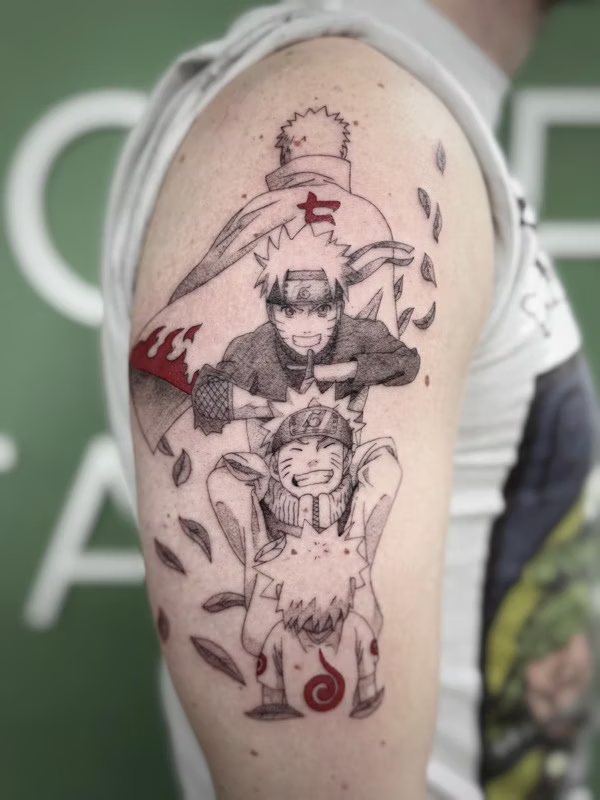
Fine line in Turin has become the defining style for those seeking an elegant, personal tattoo that fits every context of life. Hair-thin traces, millimetric detail, a visual language that speaks of care and intention. In this guide we gather the most meaningful ideas, the most requested placements, and practical tips for those approaching this style for the first time.
Why fine line is the most popular style among women
Fine line's success is not a passing fashion phenomenon — as confirmed by the tattoo trends of 2027. It is the result of a precise convergence: the technique answers real needs that other styles struggle to satisfy simultaneously. The delicacy of the stroke makes it suitable for those who want a tattoo that is present but not invasive, readable up close and nearly invisible from a distance.
Versatility is perhaps its most important quality. A fine line subject works as well on an ankle as on the ribcage, on a wrist as on the nape. The scale is completely adjustable: the same wildflower can be executed in three centimetres on the collarbone or fifteen on the arm, maintaining aesthetic coherence in both cases. This adaptability makes it ideal for those who work in professional environments where discretion matters.
Technically, fine line requires a single needle or two- to three-needle configurations placed very close together. The result is a mark with an almost photographic profile, capable of rendering textures, gradients, and microdetails that traditional styles cannot replicate without substantially increasing piece size. Fine line therefore carries narrative complexity in a small space.
It must be said honestly: it also requires careful maintenance over time. The thin stroke tends to lose definition faster than thicker lines, especially in areas subject to friction or sun exposure. But with proper care and, where necessary, a small touch-up years later, a well-executed fine line maintains its legibility for a long time.
Botanical and floral: the classic that never grows old
Suggested placements for botanical
- Inner forearm: ideal for vertical compositions with a single stem; the skin is relatively flat and aids precision
- Collarbone: perfect for small floral heads or horizontal branches following the bone line, elegant also with low-cut clothing
- Ankle: suited to discreet compositions, often a single flower or a light garland wrapping the ankle
- Ribcage: the most ambitious zone for botanicals, allowing long vertical compositions reminiscent of herbarium illustrations; pain is higher but results are extraordinary
A technical detail worth noting: botanical illustrations with roots or long stems require the tattooist to maintain constant needle pressure throughout the stroke. A minimal variation shows immediately in the final result. This is one of the reasons fine line requires specific experience — it is not enough to simply know how to work with lines of any thickness. For real examples, see our botanical tattoos in Turin.
Feminine geometric linework: softness within structure
Feminine geometric does not carry the hardness of traditional blackwork. In fine line, geometry becomes light, almost ethereal: lines that trace shapes without filling them, transparent architectures, patterns that suggest without asserting. It is a geometry that dialogues with light rather than opposing it.
Moon phases are among the most requested geometric subjects. A sequence of waning and waxing moons, each described with a hair-thin arc, creates an elegant visual rhythm that works well on horizontal zones like the collarbone, shoulder, or lower ribcage. The moon is also one of the rare geometric subjects carrying universally understood symbolic weight without needing explanation.
Fine line constellations have an interesting quality: they are nearly invisible at normal distance but reveal themselves to those who come close enough. This creates an element of intimacy in the tattoo, a code shared only with those near to you. Technically they are among the simpler works in terms of drawing complexity, but they require precision in spacing the star points and in the tension of the connecting strokes.
Fine line mandalas, on the other hand, require elevated technical skill: the symmetry must be near-mathematical, each petal must mirror its counterpart with millimetric precision. A well-executed fine line mandala is visually hypnotic; a poorly done one immediately reveals its imprecisions. This is a subject worth investing in a specialised artist for.
Technical note: for geometric work, it is essential that the skin remains evenly taut throughout execution. Even a slight variation in tension can alter a line's angle and compromise the piece's symmetry. This is one reason why your position on the bench during the session is not a minor detail.
Script and lettering: when words become skin
Font considerations
Not all fonts lend themselves equally to tattooed fine line. Characters with high contrast between thick and thin strokes — classic in Bodoni or Didot typefaces — are technically beautiful but risk losing the thinnest thin strokes after a few years. Characters with moderate contrast, like an elegant cursive or a uniform-stroke serif, tend to age better while maintaining legibility.
A practical tip: always bring a written reference of the phrase or word you want tattooed, both in print and in the style you prefer. The tattooist can help you choose a style that balances aesthetic quality with long-term durability. Avoid fonts with very narrow counter-forms (closed spaces inside letters like 'o', 'e', 'a') at very small sizes — they tend to fill in over time.
Animals and still lifes: the delicate bestiary
The animal kingdom, reinterpreted in fine line, offers a breadth of subjects well beyond the most obvious choices. Butterflies and hummingbirds are established classics — and for good reason: both lend themselves magnificently to thin strokes due to their naturally linear structure. But it is the world of insects that has been drawing the greatest interest in recent years.
The moth, the beetle, the dragonfly, even a stylised bee in pure linework: these subjects carry an almost illustrative quality reminiscent of nineteenth-century natural history plates. They also have a practical advantage: the bilateral symmetry of insects adapts well to both central placements (sternum, nape, spine) and asymmetric ones.
Cats in fine line deserve a separate mention — not for popularity, though they are among the most requested subjects, but because the way they are interpreted varies enormously from artist to artist. A fine line cat can be a simple geometric profile in a few essential strokes, or a near-realistic portrait with fur texture rendered through closely spaced parallel lines. The style choice completely changes the final result and how the piece ages.
Single-stem subjects — a single rosemary sprig, a wildflower with its roots, a lavender stalk — are among the most frequent requests and in some ways among the most difficult. The apparent simplicity conceals the need for an absolutely high-quality stroke: there is no complex composition to serve as distraction, only the purity of the line.
The most requested placements for women
Highly requested zones
- Collarbone: elegant zone, excellent for horizontal compositions, moderate pain
- Wrist: always visible, suited to small pieces and lettering, be mindful of flexion
- Ankle: discreet, good for florals and circular compositions
- Ribcage: for larger compositions, high impact, elevated pain
Trending zones 2027
- Back of the neck: high visual impact, perfect with hair up
- Inner arm: intimate zone, excellent for personal subjects and text
- Finger: trending but faster fading, recommended only for very simple pieces
- Behind the ear: ultra-discreet micro-tattoos, almost a secret
The inner arm, particularly the stretch between wrist and elbow, deserves specific attention. The skin is thin and sensitive, meaning more perceived pain during execution, but also an incredibly sharp rendering of the fine stroke. Many who choose this zone do so precisely for this quality: the tattoo seems almost printed onto the skin.
Discreet vs visible tattoos: how to choose
The decision between an easily concealed tattoo and one always visible is not just about aesthetics: it is a choice with concrete implications for daily life. It is worth thinking through honestly before fixing the placement.
The work context is still, in many sectors, a determining factor. Professions in direct public contact in formal settings — law, medicine, finance, teaching in some contexts — can still encounter prejudices around visible tattoos. It is not a universal situation, and it is changing rapidly, but ignoring it would be naive. If your current or future professional context could create friction, a concealable placement — ribcage, shoulder, thigh, back — gives you complete freedom without sacrificing aesthetics.
That said, a wrist or forearm tattoo has an advantage not to be underestimated: it is part of the visual dialogue you have every day with yourself. Seeing it while you write, while you use your hands, while you are distracted in a meeting — these are daily moments of contact with something you chose intentionally. For many people this has a value that goes beyond aesthetics.
First-timer tips: what to know before you sit down
Pain: honest and contextualised
Physical preparation
- Eat well at least two hours before the session: stable blood sugar significantly reduces the likelihood of dizziness or nausea
- Moisturise the skin of the area the day before, not the same day with heavy creams
- Avoid alcohol in the 24 hours prior: it thins the blood and compromises stroke precision
- Wear clothing that allows easy access to the area being tattooed without needing to hold uncomfortable positions
What to expect afterwards
In the first days the tattoo will appear darker and slightly swollen. During healing — which lasts on average two weeks at the surface and a month in depth — it is normal for the skin to peel slightly. Do not pick at peeling skin: this is the main risk of losing ink in a fine line. Correct aftercare involves light moisturising and sun protection; once healed, sunscreen is essential for preserving stroke definition long-term.
A studio tip: if you have doubts about subject or placement, ask us for a paper sketch before deciding. During the consultation we help you understand how it will adapt specifically to your anatomy, not in the abstract. Fine line responds differently to every curve of the body.
Frequently asked questions — fine line tattoos for women
Which fine line tattoo is most requested by women?
Botanical and floral subjects are by far the most requested: line-drawn roses, wildflowers, eucalyptus branches and horizontal collarbone compositions. Next come astronomical compositions (constellations, moon phases) and illustrative animal subjects like butterflies and dragonflies. Fine line lettering with dates or short quotes remains popular for strictly personal tattoos.
Where is it best to get a fine line tattoo?
The most requested areas are the collarbone (great for horizontal compositions), inner forearm (crisp lines), ankle (discreet, good for simple florals) and ribs (for vertical botanical compositions, with higher pain). Hands and fingers are trendy but have reduced longevity: fine line requires frequent touch-ups in these areas.
How long does a fine line tattoo last before fading?
A well-executed fine line maintains legibility for years but ages faster than thick-lined styles. Sun protection is the most decisive factor: SPF 50+ on tattooed areas after healing prolongs sharpness. In low-sun-exposure areas (inner forearm, ribs), a fine line holds up well for 7–10 years without touch-ups.
Does a fine line tattoo hurt?
Fine line itself isn't more painful than other styles, but the required precision means the artist can't stop frequently during critical passes. Low-pain areas for a first fine line: outer forearm, outer calf and thigh. Ribs, inner arm and bony areas have higher intensity — better to tackle after having some experience.
How much does a small fine line tattoo cost in Turin?
A small fine line (under 5–6 cm, simple subject) starts at €80–150 in Turin. Medium-sized pieces (8–15 cm) with botanical detail are €150–350. For large pieces such as ribs or full-arm compositions, the quote depends on execution time — the artist provides a precise quote in a free consultation.
Ready to turn an idea into something permanent? We work together from the first sketch.
Book a consultation →