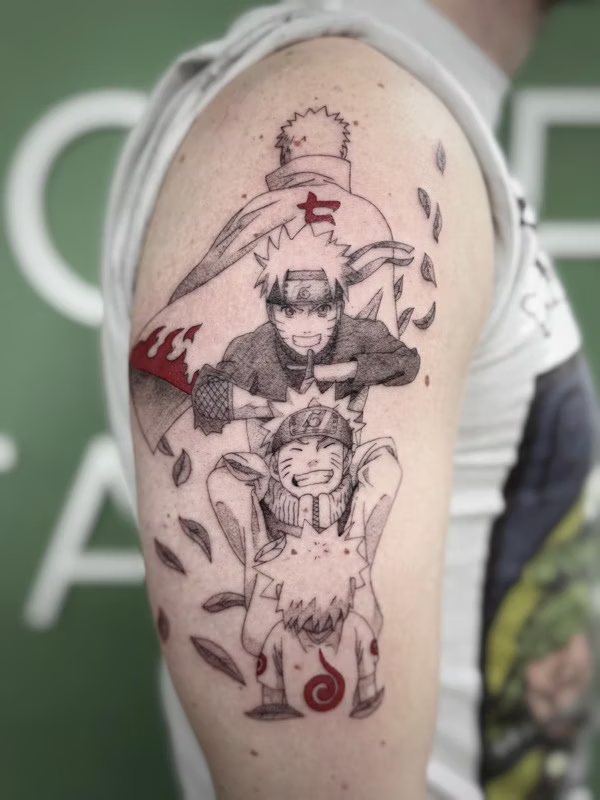
Patchwork Tattoo: What It Is and How to Build a Sleeve
Patchwork is one of the strongest tattoo trends of 2027: a collection of distinct tattoos that coexist on the same arm or body area, without a continuous graphic background. Unlike a traditional sleeve, where everything is linked by a single visual theme, patchwork lets each piece breathe, keep its own identity, and tell a fragment of a personal story. It's the perfect style for those who want to build a narrative over time.
What a patchwork tattoo actually is
The term "patchwork" comes from textiles: a composition of separate pieces, each with its own pattern, joined on the same surface but visually independent. In tattooing, this translates to a series of subjects — a flower, an animal, a phrase, a geometric shape — placed close together but not fused. The skin between each piece stays clean: it's an integral part of the composition, not an absence.
It's a style that has taken strong hold with Gen Z and younger millennials, and is now the most requested way to build a fully tattooed arm or leg without committing, from day one, to a unified project. In Turin and across Italy, patchwork has rapidly replaced the classic sleeve as the first choice for those entering tattooing with the idea of a collection growing over time.
Patchwork vs traditional sleeve: the real differences
Both approaches can cover the same body area, but the philosophy and visual result are deeply different. Understanding the distinction is essential before starting.
Traditional sleeve
A unified project with a theme, colour palette and continuous background. Pieces blend into a single image. Requires complete planning before starting, and is generally done in closely scheduled sessions. Once begun, changing direction is very difficult.
Patchwork
A collection of autonomous pieces, each with its own meaning. The bare skin between tattoos is part of the design. Built over time: you can add piece after piece across years. Maximum flexibility, maximum personalisation.
Strategic choice: if you're at the start of your journey and don't yet know whether you'll want to cover the full arm, patchwork is the smarter choice. If on the other hand you already have a clear narrative idea and want everything visually connected, the traditional sleeve remains the more powerful format.
How to plan a coherent patchwork sleeve
The main risk with patchwork is that it ends up looking random: tattoos chosen at different times, by different artists, without a common thread, wind up looking cluttered rather than curated. The difference between a patchwork sleeve that works and one that feels like an accumulation is almost always in the planning.
Pick a unifying element
The glue in patchwork isn't the subject: it's something subtler. It can be the style (all fine line, all blackwork, all illustrative), the colour palette (black only, warm tones only, pastels only), the technique (linework only, stippling only) or a conceptual theme (nature, mythology, architecture). One is enough: layering more than two risks feeling forced.
Draw a body map before starting
Even if you'll add pieces over time, it helps to have an overall vision from the first tattoo. Photograph the bare arm, print a silhouette and use it to plan where future pieces will go — even roughly. A good patchwork artist will help you balance volumes, visual density and reading direction.
Leave intentional negative space
In patchwork, the emptiness between pieces matters as much as the fill. A practical rule: leave at least 1–2 cm of clean skin between one tattoo and the next. Beyond being an aesthetic choice, it's also a technical necessity: tattoos too close together, especially if done at different times, risk creating overlap zones or ink bleeding (blowout) after healing.
Styles that work best in patchwork
Not all styles suit the patchwork format equally well. Some naturally integrate into single-piece compositions, others are born only to dialogue within a unified project.
- Fine line: the most compatible style. The lightness of the stroke lets multiple pieces coexist without overpowering each other. Ideal for delicate, dense compositions.
- Blackwork and dotwork: perfect for patchwork with strong graphic impact. The consistency of solid black visually unifies even very different pieces.
- Black-and-white illustrative: allows narrative details — small objects, animals, symbols — that read well even in isolation.
- Neo traditional: works if you keep the colour palette limited. Each piece becomes an icon, almost like collectible cards.
- Minimalist symbolic: small symbols, icons, scattered letters create an elegant, understated patchwork — often chosen as a first approach to tattooing.
Mixing styles is possible but advanced: a patchwork combining fine line and blackwork, for example, can work if the visual balance is carefully studied. It's one of the most complex projects to execute and requires an artist with strong compositional vision. Not recommended for early pieces.
Size, spacing and visual rhythm
A successful patchwork alternates large and small pieces the way good music alternates long and short notes. Avoid the "all-the-same" trap: if every piece is the same size, the eye gets lost and the composition looks flat.
The practical rule is to think in terms of 2–3 "anchor" pieces at medium-large size — 10–15 cm — around which smaller pieces of 3–6 cm orbit. Anchor pieces guide the reading, smaller pieces create detail and narrative. Avoid placing two large pieces too close: they end up competing.
Building over time: the patchwork advantage
The real value of patchwork is its episodic nature. You don't have to decide today what your arm will look like in five years. You can add a piece every six months, every year, on the occasion of important life moments. Each tattoo becomes a time capsule, and the final composition literally tells the story of who you were in those years.
Economically too, patchwork is more accessible: instead of investing €2,500–4,000 on a sleeve in a few months, you can spread the cost over time, choosing the budget you prefer for each session. It's one of the reasons this format has become dominant in recent years.
Common mistakes to avoid
Patchwork is one of the most rewarding formats but also one of the easiest to get wrong without expert guidance. Here are the mistakes we see most often.
- Pieces too close together: reduces legibility, increases blowout risk. Minimum 1–2 cm of clean skin between tattoos.
- Changing artist every piece without logic: every artist has a recognisable hand. Alternating too many different styles breaks visual coherence.
- No unifying thread: without a connecting element (style, palette, theme), the result looks messy rather than curated.
- All pieces the same size: lack of rhythm. Alternate different scales to create visual hierarchy.
- Not thinking long-term: starting without even a rough map can cause problems after a few pieces, when space becomes limited.
- Filling up too fast: patchwork rewards patience. Spaced sessions let you evaluate the result and adjust direction.
Patchwork in Turin: consultation and planning
Patchwork works best when you work with the same studio — ideally with a main artist and, occasionally, with collaborators who share a coherent visual language. This ensures the final result is a composition and not a random assembly.
At ETRA Tattoo Studio, the patchwork consultation is structured differently from a single session. We analyse the anatomy of the arm or leg, discuss the unifying element and roughly plan future pieces, even if they'll be made over the course of years. The first consultation is always free.
Frequently asked questions — patchwork sleeve
How much does a complete patchwork sleeve cost in Turin?
The cost depends on number of pieces, sizes and styles. A full arm with 8–12 pieces in fine line or blackwork in Turin can cost €1,500–3,500 over time. The spend is distributed across separate sessions: €80–250 for small pieces, €400–700 for large anchor pieces.
Can I mix different styles in a patchwork sleeve?
Yes, but it's an advanced practice that requires an artist with strong compositional vision. A patchwork combining fine line and blackwork can work if the balance is carefully studied. The key is a unifying element — style, palette or conceptual theme — that holds the pieces together. Without a connecting thread, the result looks messy.
How much space should I leave between tattoos in a patchwork?
The practical rule is to leave at least 1–2 cm of clean skin between tattoos. It's both an aesthetic choice — the empty space is part of the composition — and a technical necessity: tattoos too close, done at different times, risk blowout (ink bleeding) after healing.
Is patchwork sleeve or traditional sleeve better?
It depends on your goal. Patchwork is ideal if you want to build progressively, spread spend over time and want each piece to have its own identity. Traditional sleeve is more powerful as a unified work and works better if you have a clear narrative idea. Both have validity: there's no universally correct answer.
How long does it take to complete a patchwork sleeve?
There's no defined timeframe, which is one of the main advantages of the format. An arm with 8–12 pieces, adding one or two pieces per year, completes in 4–8 years. Many clients consider this episodic nature part of the value: each tattoo becomes a time capsule of a specific moment in their life.
Want to build a patchwork sleeve in Turin?
Discover our fine line and illustrative artists.