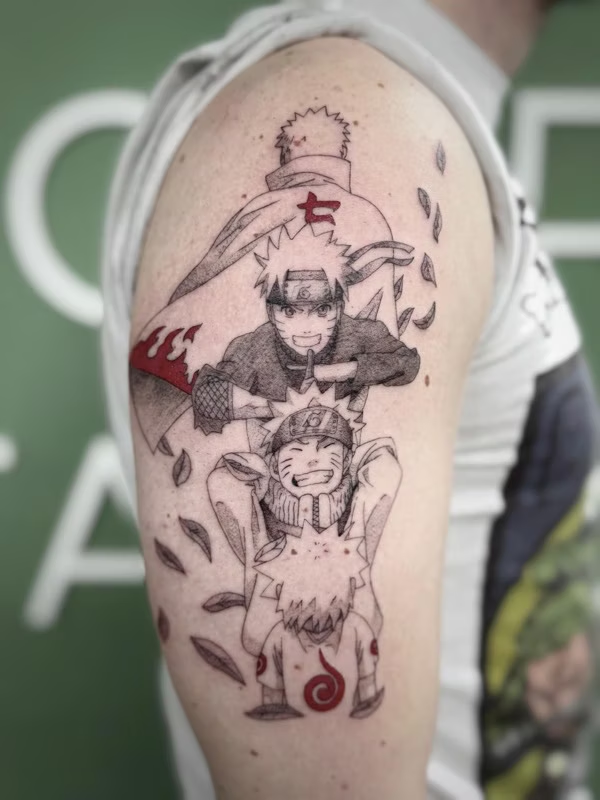
Tattoo & Sun: How to Protect Your Ink
The sun is a tattoo's worst enemy. UV rays don't distinguish between healthy skin and ink — they break down pigment, fade colours, and erase fine detail. Whether your tattoo is fresh or years old, protecting it from sun exposure isn't optional. It's basic maintenance.
How UV rays break down tattoo pigment
When you get tattooed, the ink is deposited in the dermis — the skin's deeper layer. Ultraviolet rays penetrate the epidermis and reach exactly that depth. UVA radiation (the longest wavelengths, present year-round even on cloudy days) fragments pigment molecules through a photochemical process: colour particles break into smaller pieces that the immune system removes, treating them like foreign debris.
UVB rays, more energetic and responsible for sunburn, accelerate inflammation and speed up cellular turnover, carrying away more pigment particles as the skin renews itself. The visible result: a dull tattoo with soft edges where there were once sharp lines, and colour areas that look washed out or patchy.
Key fact: UV damage is cumulative. Every unprotected session adds irreversible harm. There is no way to recover lost pigment — only a studio touch-up can restore it.
Fresh vs healed tattoos: different rules apply
Fresh tattoo (0–4 weeks)
- Zero direct sun exposure — no exceptions
- No beach, no pool, no sunbed
- Sunscreen is not enough: the skin is still an open wound
- Always cover with a lightweight cotton or linen garment
- If outdoors, choose low-UV hours (before 10am, after 5pm)
Healed tattoo (after 4 weeks)
- SPF 50+ mandatory for every exposure
- Reapply every 2 hours and after every swim
- Moisturise daily: dry skin accelerates fading
- Still avoid peak hours (10am–4pm) when possible
- After summer, consider a studio check-up
Complete tattoo healing takes an average of 3–4 weeks for surface layers, but the dermis continues to stabilise for up to 3 months. In those early weeks the skin is actively healing, and every external stimulus — sun included — interferes with the process and can cause scarring or uneven ink loss.
Which tattoo styles fade fastest in the sun
Not all tattoos react to sun exposure in the same way. Vulnerability depends on how much ink was deposited, the depth of placement, and the colour palette used.
Fine line and single needle
These are the most at-risk tattoos. Hairline-thin strokes contain very little pigment per linear centimetre: a few unprotected seasons are enough to make them nearly invisible. Microrealistic details and thin lettering suffer equally — every micron of lost ink shows immediately.
Watercolour and coloured tattoos
Light pigments — yellow, orange, pink, pale blue, aquamarine — are photochemically less stable than dark pigments. A watercolour tattoo can lose its luminosity after just one careless summer. White is the fastest-fading colour of all.
Traditional and blackwork
Traditional tattoos with bold outlines and blackwork with large solid fills hold up better because high pigment density compensates for gradual loss. That said, even black fades to grey over time without protection.
Note for ETRA clients: if you have a fine line tattoo done in studio, sun protection is not a suggestion — it is part of the final result. An unprotected fine line won't last: that's physics, not bad luck.
Which SPF to use and how to apply it correctly
Not all sunscreens are equal, and some formulations damage ink almost as much as the sun itself. Here's what to look for and what to avoid.
What to look for
- SPF 50 or 50+ — the minimum acceptable for a tattoo exposed to Italian sun
- Broad-spectrum UVA+UVB protection — check it is explicitly stated
- Alcohol-free and fragrance-free formula — alcohol dries the skin and speeds up fading
- Mineral filters (zinc oxide, titanium dioxide) for sensitive skin or fresh tattoos
- Lightweight, non-comedogenic texture — water gel or fluid emulsion
How to apply
- Apply 20–30 minutes before exposure, not as you walk out the door
- Use a generous amount: real protection drops sharply with reduced quantities
- Reapply every 2 hours, after every swim, and after heavy sweating
- Apply in circular strokes to cover outlines and colour fills evenly
Reliable products: La Roche-Posay Anthelios (fluid or gel-cream), Altruist SPF 50+, Isdin Fotoprotector Fusion Water, Eucerin Oil Control. Avoid generic scented body creams — they often list denatured alcohol as a primary ingredient.
Summer, beach, and pool: the practical strategy
Italian summers present real challenges. From the Piedmontese hinterland to the Cinque Terre or Sardinia, the UV index regularly exceeds level 8 between June and August — a level classified as "very high" by the WHO. Here's how to manage it.
At the beach
- Keep the tattoo in shade between 10am and 4pm — even under a parasol, UV reflected from sand and water is significant
- Before entering the water, wait until sunscreen has absorbed (at least 20 min)
- After every swim, rinse with fresh water (salt dries skin) and reapply SPF
- A sarong or a UPF lycra swim shirt is always more effective than sunscreen alone
At the pool
- Chlorine doesn't directly fade tattoos, but it strips natural skin lipids making the skin more UV-vulnerable
- After the pool, always moisturise with a rich cream before further sun exposure
- Avoid sunbeds: UVA lamps emit radiation up to 10–15 times more intense than summer sun
On holiday abroad
- In tropical destinations (Thailand, Bali, Caribbean) the UV index can reach 11–12+: double your sunscreen applications
- Always pack SPF 50+ — if you buy sunscreen locally, always check the spec
- For trekking or outdoor sports, choose a waterproof formula and reapply often
Signs of sun damage on a tattoo
Sun damage on a tattoo is often gradual and not always immediately obvious. Knowing what to look for lets you intervene in time — or at least understand why the tattoo is changing.
- Lines softening or disappearing: sharp outlines become blurry, especially in the thinnest strokes
- Dull or altered colours: red shifts to dusty pink, black moves toward grey, light colours disappear entirely
- Halo effect around the design: pigment disperses into surrounding tissue, creating a "blurred" or "aged" look
- Uneven texture: skin over the tattoo appears drier, flaky, or with premature micro-wrinkling
- Patchy colour density: areas of the same fill appear at different intensities, as if the colour has been "eaten" in spots
When to come to us: if after summer you notice any of these signs, book a consultation. In many cases a targeted touch-up recovers much of the lost detail — but the sooner you act, the better. Waiting years makes any restoration harder.
Seasonal advice: living with tattoos in Italy
Living in Turin and the north-west of Italy has its advantages — clear winters and warm but non-tropical summers — but the Piedmontese sun should not be underestimated, especially at altitude in the Alps or during the föhn days of July and August.
Autumn and winter (October–March)
The ideal season for getting tattooed: less sun exposure, more manageable healing, no beach to tempt you. If you ski, remember that at 2,000 metres altitude the UV index is roughly 25% higher and snow reflects up to 80% of radiation. Cover tattoos with technical garments or apply at least SPF 30.
Spring (April–May)
The UV index rises rapidly from April. Many people get their first sunburn of the year in spring precisely because cool temperatures lead them to underestimate the sun. If you got tattooed in winter, spring is the first real test: start using SPF 50+ from April onwards.
Summer (June–September)
Maximum caution required. In Turin the UV index peaks at 8–9 in July, with even higher values on the Ligurian Riviera or in Sicily. Think of summer as a challenge to actively manage: SPF every morning as part of your routine, reapplication in the afternoon, covering clothing during peak hours. If you're planning a new tattoo, note that June–August is the most difficult period for healing with outdoor exposure.
Practical rule for Turin: if your shadow is shorter than you are, the sun is high enough to damage your ink. Apply sunscreen.
Want a tattoo that keeps its colour over time? Our artists will advise you on the right style.
Free consultation.