How Long Does a Tattoo Last? Everything you need to know
A tattoo is permanent — but it is not unchanging. Over the years ink migrates, outlines soften and colours shift in tone. Understanding why this happens, and what you can do to slow it down, is the difference between a piece that ages with grace and one that wears out before its time.
The science: why ink stays in the skin
The dermis as a permanent archive
When the needle passes through the epidermis — the surface layer that constantly renews itself — and deposits ink into the dermis, the body reacts as though it has suffered a micro-injury. Macrophages, immune cells tasked with eliminating foreign substances, attempt to engulf the pigment particles. The particles are however too large to be fully cleared: they remain trapped in the connective tissue of the dermis, where certain cells hold them indefinitely.
This is why tattoos last a lifetime: the ink sits in a stable layer, beneath the normal cell-renewal cycle of the epidermis. But "permanent" does not mean "motionless". Over time, and under the effect of various factors, the particles tend to spread laterally — the phenomenon we see as fading or loss of line sharpness.
Key fact: 95% of a tattoo's longevity depends on three things — the quality of execution, the placement on the body, and the daily care you give your skin. The artist controls the first two; the third is up to you.
What causes a tattoo to fade
The main enemies of ink
Sun exposure. UV rays are by far the most aggressive degradation factor. Ultraviolet radiation breaks down pigment molecules, causing progressive fading and flattening colour gradients toward lighter, duller tones. It does not matter how fresh the tattoo is: without sun protection, the process accelerates visibly within the first months.
Friction and movement. Areas of the body subject to heavy rubbing — hands, fingers, ankles, feet — wear down ink more quickly. Skin in these areas regenerates at a faster rate, carrying away small amounts of pigment with each cell cycle.
Skin hydration. Well-hydrated skin maintains a compact structure that holds ink particles better. Chronically dry skin tends to flake more frequently, accelerating pigment loss in the more superficial layers of the dermis.
Weight changes. Significant weight gain or loss alters the structure of the dermis, can cause micro-distortions in designs, and in the case of rapid loss encourages skin laxity that makes edges less defined.
Skin ageing. With age collagen decreases, skin loses elasticity and density. Even without other risk factors, the dermis becomes less compact and tattoos naturally tend to soften and spread slightly.
Attention: Tanning creams and UV beds are equally damaging. If you have been tattooed recently, avoid any form of UV exposure on the tattoo for at least 4 weeks — and then always use SPF 50+ for the rest of the tattoo's life.
Which styles age best?
Style longevity comparison
Not all tattoos age the same way. Style — and in particular ink density, line weight and colour palette — has an enormous effect on how a piece holds up over time.
Long-lasting styles
- Blackwork / Neo-Traditional: thick lines and solid black fills hold up for decades without touch-ups. Contrast remains strong even with natural ink migration.
- American Traditional / Japanese: bold outlines and a limited palette (red, black, green, yellow) age consistently. These styles were designed to last.
- Geometric / Blackout: large monochromatic surfaces maintain their visual impact over time. Geometric patterns may soften at the edges, but the overall result remains legible.
Shorter-lasting styles
- Watercolour: the absence of hard outlines and the use of diluted pigments make this style the most prone to fading. Without a supporting black outline, colours tend to "dissolve" within 5–8 years.
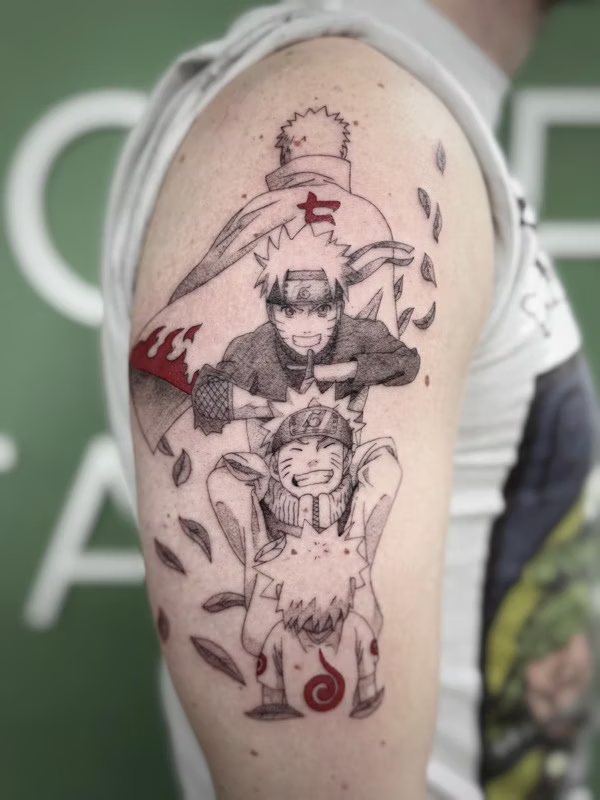
- Fine Line: ultra-thin lines are beautiful when fresh but require more attention over time. On oily skin or high-friction areas, they can lose definition within 3–5 years.
- Pastel colour / White ink: light pigments fade faster than dark ones. White ink in particular tends to yellow or become invisible within 2–3 years on most skin types.
Note: Even fine line, if executed with the correct technique and cared for attentively, can age very well. The key is the depth at which the ink is deposited and post-tattoo aftercare. Read our dedicated guide.
Placement: where you put your tattoo matters enormously
High fading-risk zones
- Hands and fingers: the skin on the hands renews rapidly and is subject to frequent washing, constant friction and detergents. Tattoos on fingers and knuckles require frequent touch-ups (sometimes every 1–2 years) to maintain definition.
- Feet and ankles: friction from footwear, sun exposure and seasonal swelling make this area unstable for fine details.
- Elbows and knees: the skin in these areas bends and stretches continuously, stressing the ink and encouraging lateral spread of particles.
- Lips and mouth: labial mucosa is not standard dermis — ink tends to migrate very quickly.
Long-lasting zones
- Back and shoulder blades: thick skin, rarely exposed to the sun in daily life and with moderate movement. Tattoos here age very well even after decades.
- Upper arm (bicep/tricep): a classic zone for good reason. Good dermal thickness, easily protected from the sun, low direct friction.
- Chest and ribs: excellent for ink longevity, even though the ribs are among the most painful areas. Skin here is generally thin but not prone to friction.
- Thighs and calves: good dermal depth and less exposure to continuous friction compared to the hands. Tattoos hold their definition for a long time.
Skin type: the personal factor
Skin is not the same for everyone — and this translates into very different ink behaviour over time.
Oily skin
Excess sebum can interfere with the initial healing of the tattoo and, in the long term, contributes to a "blurred" effect on fine line details. The more open pores typical of oily skin make the surface less compact. Those with oily skin should gravitate towards styles with weightier lines, or plan for more frequent touch-ups with fine line work.
Dry skin
Dry skin tends to flake more frequently, which can extend healing times and cause ink "loss" during the first weeks. Daily moisturising is not optional advice: it is an integral part of tattoo longevity.
Skin tone
Dark pigments (black, grey, dark blue) show on all skin tones and age predictably. Light colours — yellows, whites, lilacs — may appear less vivid on very dark skin or even invisible on medium-dark tones. If you have an olive or dark complexion, your artist should factor this into the palette selection: it is not a limitation, but a design parameter.
Practical tip: Regardless of skin type, the time of day you moisturise your tattoo matters. Applying moisturiser immediately after showering, when skin is still slightly damp, maximises absorption and keeps the dermis in optimal condition.
Touch-ups: when to get one, what it costs, what to expect
The post-healing touch-up
Most studios — including ETRA — offer a free touch-up within 2–3 months of the initial session. This is not a sign of poor execution: it is an acknowledgement that healing is an unpredictable biological process. In some spots the skin may "reject" small amounts of ink during peeling, leaving areas slightly less intense. The touch-up serves to even out the final result.
Long-term touch-ups
Outside the post-healing window, touch-ups are ordinary maintenance, not a defect. It depends on style and placement: a blackwork on the back may need no touch-ups for 15–20 years; a fine line on the fingers might need one every 2 years. The cost of a touch-up is generally lower than the original session — you are working over already-tattooed skin with less impact overall.
Signs it is time for a touch-up
- Areas with missing or uneven ink (visible as "gaps" in fills)
- Lines that have thinned or broken over time
- Overall reduced contrast — the tattoo looks "dull"
- Colour gradients that have become flat or faded unevenly
Signs of poor healing (not normal fading)
- Ink loss in large patches within the first 2–3 weeks — may indicate infection or an allergic reaction to the pigment
- Persistent swelling, redness or discharge beyond day five
- Abnormal raised texture or swelling of the tattooed area after full healing
- Intense itching returning months after the session — a possible sign of delayed reaction
Rule of thumb: If you have doubts about healing, contact your tattoo artist before applying any product to the area. Do not scratch, rub, or cover with occlusive dressings without professional advice.
How to make your tattoo last as long as possible
The daily habits that make a difference
- SPF 50+ every time you go out: this is the single most effective thing you can do. Apply sunscreen to the tattoo every morning if it is in an exposed area, and every time you go to the beach or mountains. Do not wait for strong sun: even diffuse light accumulates UV damage over time.
- Moisturise daily: a fragrance-free emollient applied every day keeps the dermis elastic and compact, slowing the natural lateral diffusion of ink particles.
- Avoid excessive water exposure: long swims in pools (especially chlorinated) or the sea erode the skin's lipid layer and can accelerate pigment loss. A shower is always preferable to a long bath.
- Do not smoke: smoking reduces skin microcirculation and degrades dermal collagen — two factors that accelerate skin ageing and, consequently, the ageing of your tattoo.
- Maintain a stable weight: avoiding rapid and significant weight fluctuations protects the structure of the dermis and reduces the risk of design distortion.
- Choose gentle cleansers: aggressive soaps and mechanical scrubs on the tattooed area accelerate epidermal cell turnover. Use a pH-neutral cleanser and avoid exfoliants on tattooed skin.
Keep in mind: A tattoo that ages is not a "ruined" tattoo. Change over time is part of the nature of this form of body art. What distinguishes a well-aged piece from a poorly-aged one is often the quality of the original execution — and the choices you make afterward.
Want a tattoo that lasts? Our artists use CE-certified inks.
Free consultation in Turin.
Recent articles
Book a free consultation
Tell us your idea. Free consultation, no commitment. We reply within 24 hours.


Request sent ✓
We'll be in touch within 24 hours to confirm your consultation.
Rather message us right away?
Via Monte di Pietà 19/C, 10122 Torino · Tue–Sat 11:00–18:30